
Monthly Intelligence Reports

ANALYTICSMONTHLY-BRIEF

30‑day summaries that preserve continuity, reveal long‑running patterns, and reduce false “first‑seen” claims.

Strategic Intelligence Analysis

2025 Comparative Review
STRATEGIC-2025-001Air Activity Patterns: Taiwan Strait vs. Baltic SeaGenerated: 25/02/2026
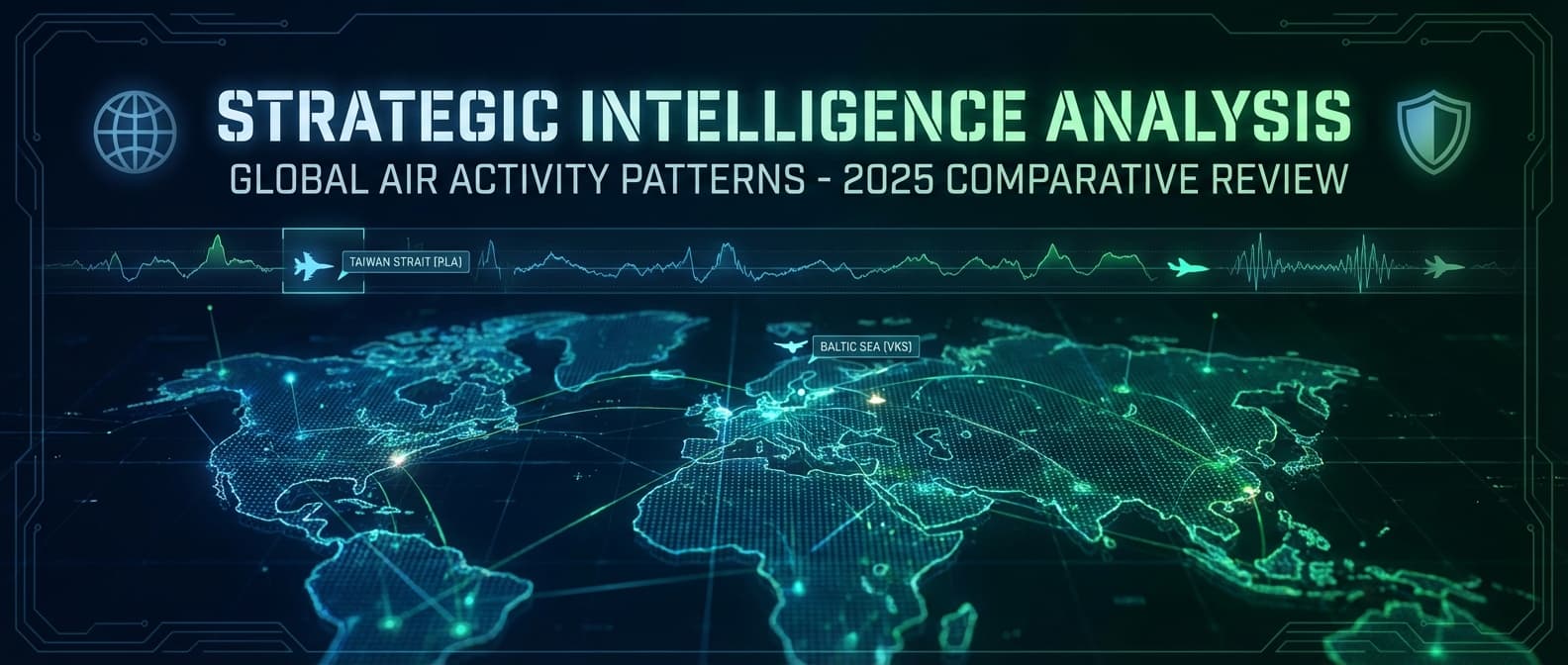
Strategic Air Activity Visualization

Eurasian Air Friction

Visualizing the divergence in PLA and VKS coercive strategies

Tactical & Strategic Comparison

2025 Strategic Air Activity Comparison

Taiwan Strait (PLA) vs. Baltic Sea (Russian Federation)

Date: January 6, 2026 Classification: OPEN SOURCE / OSINT ANALYTICAL PRODUCT Scope: Comparative analysis of 2025 air activity patterns, sovereignty violations, and strategic intent.


Executive Summary

In 2025, global air domains witnessed divergent strategies of coercion. The People's Liberation Army (PLA) pursued a high-frequency, volume-centric strategy around Taiwan, normalizing presence within the Air Defense Identification Zone (ADIZ) to erode threat awareness and simulate blockade operations. Conversely, Russian Federation Aerospace Forces (VKS) in the Baltic region exhibited a lower-volume but higher-risk profile, characterized by direct sovereign airspace violations, armed signaling with strategic bombers, and aggressive hybrid warfare tactics (GNSS jamming).

Taiwan Strait

increasing

Transition from signaling to operational blockade rehearsal is complete.

IMPLICATION: Expect sortie rates to exceed 400/mo by Q3 2026, targeting defender exhaustion.

Baltic Flank

shifting

Shift from intercept volume to high-risk nuclear signaling & hybrid warfare.

IMPLICATION: Kinetic intercept risk remains low, but GNSS jamming will disrupt civil aviation persistently.

Global Assessment

stable

Strategies are divergent, not coordinated.

IMPLICATION: Low probability of synchronized dual-theater offensive in 2026 despite opportunistic timing.

Average Monthly Activity (2025)

300

Taiwan Strait (PLA)

Avg Sorties/Mo

300

45

Baltic Sea (Rus)

Avg Intercepts/Mo

45

Confirmed 12NM Airspace Violations

0

PLA (Taiwan)

Territorial (12NM)

0

4

VKS (Finland/Estonia)

Territorial (12NM)

4

Strategic Profile: Volume vs. Escalation Risk

High Escalation Risk
High Sortie Volume
Low Activity
PLA Air Force
PLA Air Force
High Volume, Low Sovereign Violation Risk (Gray Zone)
Vol: 90% | Risk: 20%
Russian VKS
Russian VKS
Low Volume, High Escalation Risk (Direct Violations)
Vol: 25% | Risk: 85%
X-Axis: Sortie Frequency (Normalized) • Y-Axis: Sovereign Violation Severity

5-Year Strategic Trend (Annual Activity)

0990198029703960PLA Incursions (Annual) (2021): 972PLA Incursions (Annual) (2022): 1737PLA Incursions (Annual) (2023): 1703PLA Incursions (Annual) (2024): 2200PLA Incursions (Annual) (2025): 3600NATO BAP Intercepts (Annual) (2021): 100NATO BAP Intercepts (Annual) (2022): 200NATO BAP Intercepts (Annual) (2023): 300NATO BAP Intercepts (Annual) (2024): 400NATO BAP Intercepts (Annual) (2025): 50020212022202320242025
PLA Incursions (Annual)
NATO BAP Intercepts (Annual)

*2024-2025 figures extrapolated from Q1-Q3 annualized rates.

1. The Taiwan Theater: Saturation and Blockade Rehearsal

PLA activity in 2025 marked a definitive shift from punitive signaling to operational rehearsal, maintaining a "new normal" of median line crossings.

Activity Indicators

  • Volume & Frequency: Averaged ~300 sorties per month in 2025.
    • Peak Activity: December 2025, with 274 total sorties. A single surge during "Justice Mission 2025" (Dec 29-30) saw 125 sorties in 48 hours.
    • Early Year Surge: January 2025 recorded 248 aircraft, setting a high baseline for the year.
  • Sovereignty Status:
    • Zero confirmed violations of Taiwan's 12 NM territorial airspace.
    • High frequency of "Contiguous Zone" (24 NM) approaches, pressing the psychological buffer.
    • Standardized crossings of the Taiwan Strait Median Line, effectively erasing it as a de facto boundary.

Tactical Composition

  • Platforms: Mix of 4th/5th gen fighters (J-10, J-16), H-6 nuclear-capable bombers, and significant usage of KJ-500 AEW&C for battle management.
  • Unmanned Systems: Increased integration of BZK-005 and TB-001 "Twin-Tailed Scorpion" drones for long-endurance surveillance and encirclement flights.
  • Balloon Program: December 2025 saw a resurgence of surveillance balloons traversing the ADIZ, some transiting directly over the island at intelligence-collection altitudes.

Strategic Drivers

  • Exercises: "Strait Thunder-2025A" (April) and "Justice Mission 2025" (December). The latter specifically simulated a maritime and aerial blockade, integrating 14 PLAN vessels.
  • Intent: Desensitization of defenders, exhaustion of ROCAF airframes, and political signaling against the Lai administration.

2. The Baltic Theater: Brinkmanship and Hybrid Threats

Russian air activity in the Baltic / Gulf of Finland was characterized by sharp, unpredictable provocations rather than mass saturation.

Activity Indicators

  • Volume: Significantly lower than the Taiwan theater (dozens of intercepts vs. hundreds), but with higher kinetic risk.
  • Sovereignty Violations (Confirmed):
    • September 19, 2025: Three MiG-31 Foxhound interceptors violated Estonian airspace over the Gulf of Finland for ~12 minutes. Transponders off, no flight plan.
    • May 2025: Two Russian aircraft suspected of violating Finnish airspace near Porvoo (2.5km depth).
  • International Airspace Incidents:
    • May 2025: Su-24 Fencer performed "dangerous maneuvers" near Polish Air Force jets.
    • August 2025: NATO Baltic Air Policing scrambled twice for Su-33 and Su-24MR operating without comms/transponders.

Tactical Composition & Hybrid Warfare

  • Strategic Signaling: November 2025 featured a 5-hour patrol by Tu-22M3 Backfire bombers carrying Kh-32 supersonic anti-ship missiles, a clear nuclear/anti-carrier signal to NATO.
  • Electronic Warfare: Widespread GNSS/GPS jamming affecting civil aviation across the Baltic, attributed to Russian EW assets in Kaliningrad and the Gulf of Finland.
  • "Shadow Fleet" Protection: Increased air patrols correlating with the movement of sanctioned oil tankers, signaling a resolve to defend economic lifelines.

Strategic Drivers

  • Response: NATO "Eastern Sentry" activity and reinforced Air Policing (Italy, France, Spain, Netherlands) at Ämari and Lielvārde Air Bases.
  • Intent: Testing NATO Article 5 cohesion, probing new member (Finland/Sweden) integration, and asymmetric "gray zone" disruption via electronic warfare.

3. Synthesis & Conclusion

FeatureTaiwan Strait (PLA)Baltic Sea (Russia)
Primary TacticMass Saturation / Gray ZoneProbe & Provoke / Brinkmanship
SovereigntyRespects 12NM (creates "squeeze")Direct Violations (12NM breaches)
Key RiskAccident via Density / Blockade Fait AccompliShoot-down / Article 5 Trigger
TempoConstant, high-volume (Daily)Episodic, spike-based (Monthly)
Strategic GoalNormalization of presence, blockade rehearsalIntimidation, alliance fracturing

Assessment: While the PLA presents a greater operational capacity threat through its ability to sustain blockade-level sortie rates, the Russian VKS presents a higher immediate escalation risk due to its willingness to physically violate sovereign airspace and engage in aggressive maneuvering against NATO assets. The PLA is eroding the status quo through volume; Russia is challenging the status quo through shock.


Methodology & Sources

Analytical Framework: This comparison utilizes a normalized indexing of air sorties against sovereign boundaries (12NM) and functional boundaries (ADIZ/International Airspace). Data has been cross-referenced across multiple defense ministries to filter out duplicate reporting of single incidents.

Primary Data Sources:

  1. Taiwan Ministry of National Defense (MND): Daily situational reports on PLA aircraft and vessel movements.
  2. NATO Allied Air Command (AIRCOM): Public statements on Baltic Air Policing (BAP) scrambles and "Alpha" intercepts.
  3. National Defense Ministries: Official disclosures from the Finnish Defence Forces, Estonian Defence Forces, and Polish Ministry of National Defence.
  4. OSINT Aggregators: PLA Tracker, CSIS ChinaPower, and Institute for the Study of War (ISW) regional updates.
  5. Technical Intelligence: Comms/Transponder monitoring logs and GNSS interference maps from GPSJam.org and Baltic regional civil aviation authorities.

We only use optional analytics cookies if you allow them. Necessary cookies stay on for sign-in and site security.

Learn more in our Privacy Policy.